A few years ago, if someone had asked retail experts to name the future of consumer brands, Everlane would have been near the top of the list.
The company seemed to have everything figured out.
It sold directly to consumers. It preached transparency. It built a loyal following among younger shoppers who were tired of traditional retail. Investors poured money into the company. The media treated it as a case study for what modern retail should become.
For a while, everyone looked smart.
Then the story changed.
This year, reports surfaced that Everlane had been sold to Shein for roughly $100 million. For most companies, a $100 million sale would be considered a success. But Everlane wasn't most companies. This was a brand that had once been discussed as one of retail's brightest stars. A company that represented the future.
Instead, it became another reminder that there is a significant difference between building a popular brand and building a durable business.
As I read through the coverage of Everlane's sale, I couldn't help but think about the mattress industry.
Not because Everlane sold mattresses.
Not because direct-to-consumer retail failed.
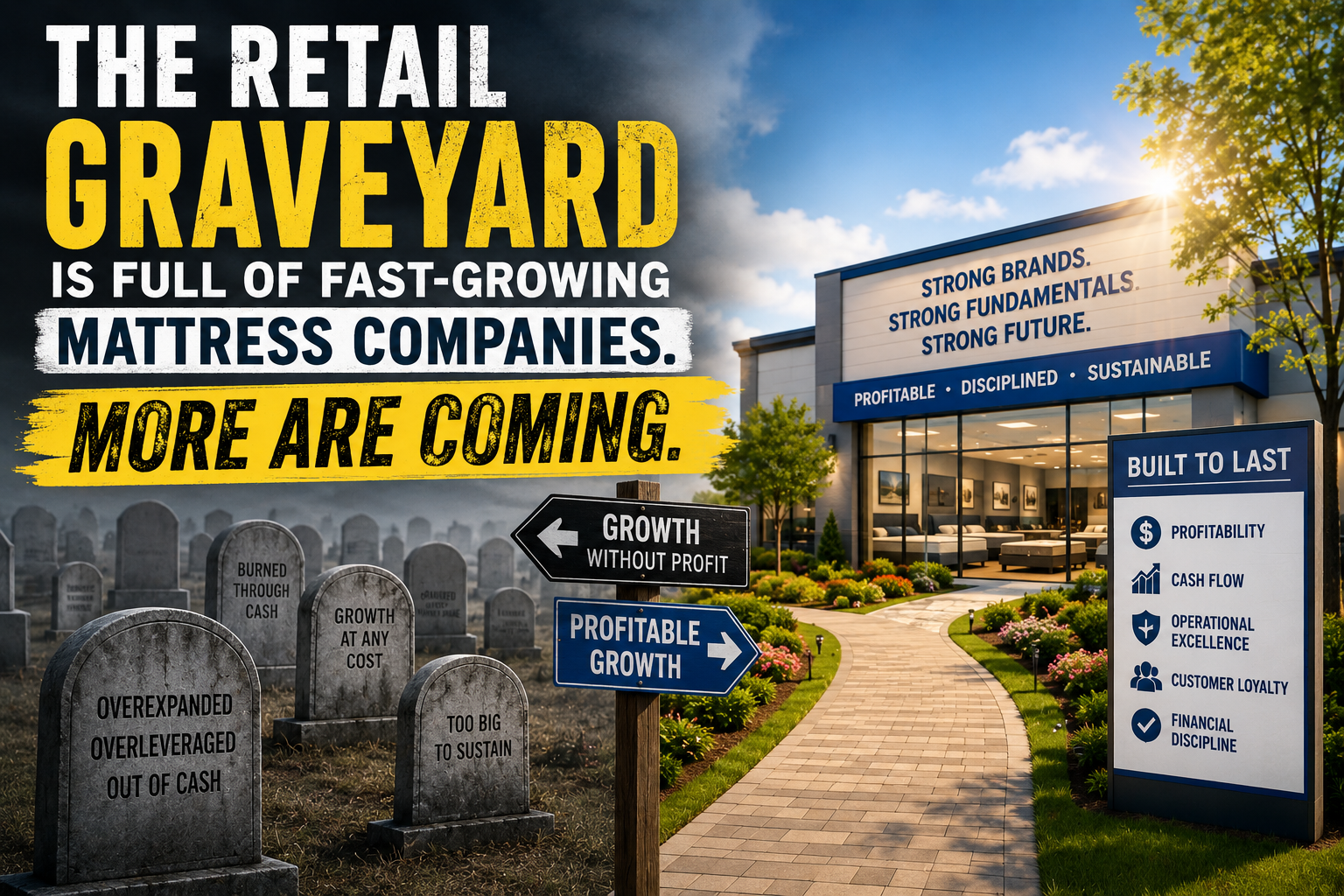
But because our industry has spent the better part of two decades chasing many of the same things that made Everlane famous: growth, scale, market share, investor excitement, and the belief that getting bigger would eventually solve every other problem.
The mattress industry has always loved a growth story.
We celebrate store openings. We celebrate acquisitions. We celebrate expanding distribution, increasing revenue, and gaining market share. Those things matter, and in many cases they should be celebrated.
But history suggests something uncomfortable.
Many of the companies that dominated industry conversations ten years ago are gone, bankrupt, acquired, dramatically smaller, or fighting battles nobody could see when the growth charts were heading up and to the right.
That's because growth has a way of disguising weaknesses.
When revenue is climbing, few people ask difficult questions.
When investors are excited, profitability often becomes a secondary concern.
When expansion is working, operational inefficiencies are easier to ignore.
Success creates confidence. Sometimes too much confidence.
The challenge comes later.
Eventually every business reaches the point where growth slows. The market changes. Customer acquisition becomes more expensive. Margins tighten. Capital becomes harder to access. Suddenly the business is forced to stand on its own fundamentals.
That's where the difference between a growth story and a great business becomes obvious.
The mattress industry has seen this movie before.
Mattress Firm wasn't short on customers when it entered bankruptcy. Purple wasn't lacking consumer awareness when investors began demanding a clearer path to profitability. Countless regional chains that once seemed dominant discovered that expanding faster than their fundamentals could support came with consequences.
The details are different every time.
The lesson is usually the same.
Growth is not a substitute for profitability.
Growth is not a substitute for cash flow.
Growth is not a substitute for operational excellence.
And growth is certainly not a substitute for a business model.