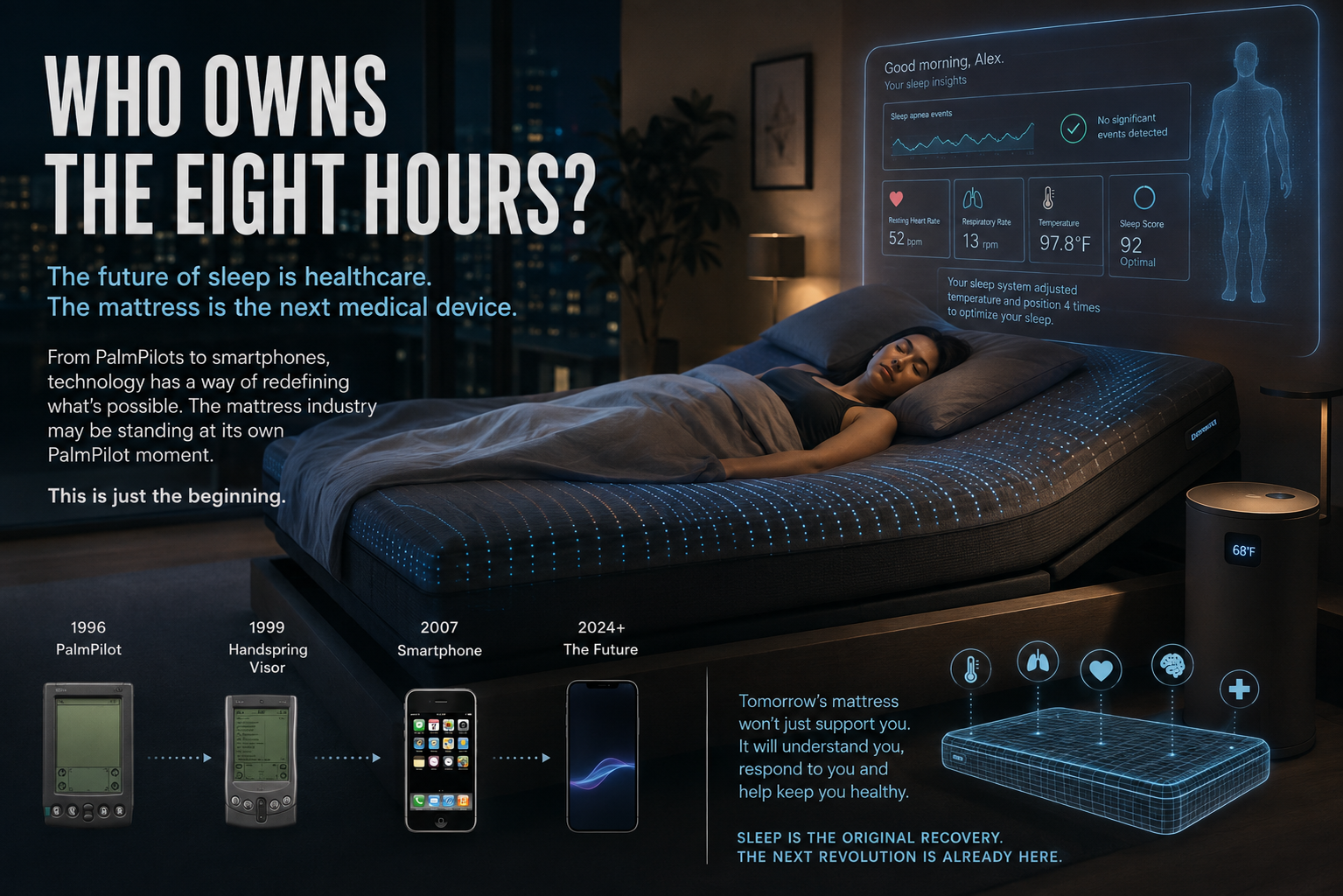
There was a time when a PalmPilot felt like the future.
If you were really ahead of the curve, maybe you had a Handspring Visor clipped to your belt. You could keep your calendar, contacts and notes in your pocket. It felt revolutionary.
Then the smartphone arrived.
Today, we carry cameras, GPS systems, payment terminals, televisions, libraries, translation devices, health monitors and more computing power than early spacecraft navigation systems in our pockets.
And almost nobody carries a PalmPilot anymore.
I keep wondering whether the mattress industry is standing at its own PalmPilot moment.
Because what if the mattress we sell today, layers of foam, springs, fabric and maybe an adjustable base underneath, is only the primitive beginning of what a sleep system eventually becomes?
What if sleep becomes healthcare?
And what if the mattress becomes a medical device?
That possibility doesn't feel nearly as crazy as it did even five years ago.
Eight Sleep May Be Showing Us the First Glimpse
A recent report about Eight Sleep caught my attention, but not because the company sells a roughly $3,000 temperature controlled mattress cover to wealthy customers.
The interesting part is where the company wants to go next.
Eight Sleep is pursuing FDA clearance for technology designed to detect and potentially mitigate sleep apnea. The company is conducting clinical studies, including work around automatically repositioning sleepers suffering from apnea, with the ultimate ambition of having insurers view its technology as a medical device rather than simply an expensive consumer gadget.
Think about how significant that distinction is.
Today the conversation is:
"Would you spend $3,000 to sleep cooler?"
Tomorrow it could become:
"Does your insurance cover your sleep system?"
Those are two completely different industries.
And Eight Sleep isn't operating in a vacuum.
The FDA cleared Apple's Sleep Apnea Notification Feature in 2024, allowing compatible Apple Watches to identify breathing disturbance patterns that may indicate moderate to severe sleep apnea. Samsung received FDA authorization for its own sleep apnea risk assessment feature that same year.
These aren't substitutes for full medical diagnosis, but they show how quickly consumer electronics are moving toward regulated healthcare.
The FDA is also already authorizing sensor based digital health devices intended for continuous health monitoring outside traditional clinical settings, including in people's homes.
Now imagine what happens when the largest health monitoring surface in your home isn't on your wrist.
It's the thing you spend eight hours lying on every night.
Your Bed Knows More About You Than Your Watch Ever Could
A smartwatch touches you all day.
A mattress gets something completely different.
Eight hours of relatively controlled observation.
Every night.
Same person. Same environment. Same surface.
Think about the potential data.
Heart rate.
Respiratory rate.
Body temperature.
Movement.
Sleep position.
Snoring.
Restlessness.
Heart rate variability.
Bed exits.
Pressure distribution.
Sleep duration.
Sleep consistency.
Possibly oxygenation.
Potentially changes in body weight.
And someday perhaps additional biomarkers we haven't even figured out how to measure passively yet.
The FDA already recognizes medical monitoring systems that use sensors under mattresses to track patient activity.
So let's put our futurist hat on.
What happens when all of those sensors get dramatically cheaper?
What happens when artificial intelligence gets dramatically better at interpreting them?
And what happens when your mattress has five years of baseline data about you?
That's when things get really interesting.
Because your mattress may eventually recognize that something is wrong before you do.
Imagine the Bed of 2040
You go to sleep.
You don't attach anything.
You don't wear anything.
You don't fill out a questionnaire.
The bed already knows you.
At 2:13 a.m., your breathing pattern changes.
The mattress recognizes airway obstruction and gently elevates the head of the bed.
Your sleeping position changes.
Breathing improves.
The system slightly adjusts temperature because it has learned exactly where your body sleeps most efficiently during each stage of sleep.
Later that night, pressure sensors detect that you've remained in one position longer than normal.
The surface subtly changes firmness beneath your shoulder and hip.
You never wake up.
Meanwhile, the system notices your resting heart rate has been slowly increasing for six nights.
Your respiratory patterns have changed.
Your temperature baseline is slightly elevated.
Instead of telling you:
"Sleep Score: 78."
It tells you:
"Your respiratory and temperature patterns have deviated significantly from your 12 month baseline. Consider contacting your physician."
Maybe your doctor already has the data.
Maybe the system books the telehealth appointment.
Maybe it detects the earliest signs of respiratory illness.
Maybe cardiovascular problems.
Maybe sleep apnea.
Maybe changes associated with medication.
Maybe neurological conditions that first reveal themselves through changes in sleep movement.
Maybe metabolic changes.
I don't know exactly which of these will become possible.
Nobody does.
That's the point.
Someone looking at a Handspring Visor in 1999 probably wasn't predicting Uber, FaceTime, TikTok, mobile banking and an AI assistant running on the device that would replace it.
Technological disruption rarely looks obvious from the starting line.
The Biggest Breakthrough May Not Be Monitoring
Here's where I think the mattress industry needs to think much bigger.
Tracking sleep is interesting.
Changing sleep in real time is revolutionary.
That's the difference between observation and intervention.
A wearable can tell me I'm hot.
My bed can cool me.
A wearable can detect that my heart rate increased.
My mattress can potentially change my position.
A sensor can tell me I'm experiencing excessive pressure.
A future sleep surface could redistribute that pressure.
A device can identify snoring.
A bed could elevate me automatically.
This is already part of what Eight Sleep is investigating with sleep apnea. Its clinical work is exploring whether automatic repositioning could mitigate apnea events, potentially creating an alternative or complement to traditional therapies such as CPAP for some patients.
Whether regulators ultimately clear that capability remains to be seen.
But the bigger concept matters.
Today's bed is passive.
Tomorrow's bed could be responsive.
And eventually it could become predictive.
That's an enormous leap.
Healthcare Is Going to Move Into the Bedroom
For the last hundred years, healthcare has primarily happened when something goes wrong.
You don't feel good.
You make an appointment.
Someone takes measurements.
Doctors try to figure out what changed.
But technology is moving healthcare toward continuous monitoring.
We already see it with glucose monitors.
Heart monitors.
Smartwatches.
Smart rings.
Connected blood pressure devices.
The FDA specifically defines and regulates digital health technologies that continuously or periodically collect health information outside hospitals and doctors' offices.
Sleep may be one of the most valuable windows into human health.
And unlike a smartwatch that someone may forget to charge or a ring they might take off, almost everyone does one thing every night:
They get in bed.
That makes the sleep environment an incredible healthcare platform.
Not just the mattress.
The mattress.
The adjustable base.
The pillow.
Temperature control.
Lighting.
Sound.
Air quality.
Wearables.
AI.
All communicating.
Instead of selling a mattress, somebody eventually sells a personal sleep operating system.
And That's Where Our Industry Should Be Paying Attention
Here is the uncomfortable question.
Who is going to build it?
Will it be the companies currently dominating the mattress industry?
Tempur Sealy?
Serta Simmons?
3Z Brands?
Purple?
Sleep Number under its next chapter?
Leggett & Platt working with manufacturing partners?
Or does the future come from outside the traditional mattress industry entirely?
Eight Sleep?
Apple?
Google?
Samsung?
Oura?
WHOOP?
A healthcare company we've never heard of?
Some 22 year old working in a garage right now?
Because history isn't particularly kind to incumbents during major technological transitions.
Kodak understood photography.
Nokia understood phones.
BlackBerry understood mobile communication.
Palm understood handheld computing.
That didn't guarantee any of them ownership of the next generation.
Sometimes knowing the existing industry too well becomes a disadvantage.
You become focused on improving the existing product instead of imagining the product that replaces it.
And that may be the biggest danger facing mattress manufacturers.
We're currently having serious conversations about whether next year's foam should have another cooling additive.
The disruptor might be asking whether the mattress can identify atrial fibrillation.
We're debating coil counts.
They're debating biomarkers.
We're adding another inch of foam.
They're hiring software engineers and medical researchers.
Those are very different races.
The Landline Lesson
Think about telecommunications.
Cellphones didn't simply make landline phones better.
They eventually made the landline increasingly irrelevant.
That distinction matters.
Disruption doesn't always improve an existing category.
Sometimes it redefines what category you're competing in.
If mattresses become healthcare platforms, then mattress companies may eventually discover they aren't primarily competing against other mattress companies.
They may be competing against technology companies.
Healthcare companies.
Insurance companies.
Artificial intelligence companies.
Medical device manufacturers.
The competitive advantage might no longer be:
"We make really good foam."
It could become:
"We have 12 years of longitudinal sleep data from 40 million people."
That's one hell of a moat.
The Business Model Could Change Too
This is where things could get truly disruptive for retailers and manufacturers.
Today, mattress economics are relatively simple.
Manufacturer makes mattress.
Retailer sells mattress.
Consumer pays for mattress.
Repeat every seven to ten years.
But what if the future model looks more like this?
A $5,000 sleep system.
Insurance covers $3,500 because it is prescribed for a qualifying condition.
The consumer pays $1,500.
The manufacturer earns recurring revenue from health monitoring.
The retailer receives revenue for setup, calibration and ongoing service.
Software gets updated every year.
Sensors get replaced every three years.
The mattress itself becomes only one component of a much larger ecosystem.
Suddenly our industry's obsession with mattress replacement cycles looks incredibly outdated.
The customer relationship wouldn't end when the delivery truck leaves.
It might just be beginning.
Mattress Stores Could Become Sleep Health Stores
That creates an equally interesting question for retailers.
What does a mattress store look like in 15 years?
Maybe the great mattress retailer of the future doesn't simply ask:
"Do you like firm or soft?"
Maybe they ask:
How do you sleep?
How do you breathe?
What's your normal sleeping temperature?
Do you snore?
What's your recovery score?
Do you have circulation issues?
What does your doctor recommend?
Then technology maps your body, analyzes pressure, imports information from your wearable and configures an individualized sleep environment.
The salesperson becomes something closer to a sleep technology specialist.
That could fundamentally change the credibility of mattress retail.
For decades, we've told consumers:
Sleep is essential to your health.
Eventually regulators, doctors and insurers may begin treating the products responsible for that sleep accordingly.
That's both an incredible opportunity and a massive challenge.
Because once you're selling healthcare technology, claims matter.
Clinical evidence matters.
Data security matters.
Regulation matters.
Training matters.
The FDA already makes that distinction very clear. Consumer technology can't simply call itself diagnostic or therapeutic because the marketing department wants it to.
Medical claims bring medical device scrutiny.
The industry would have to grow up quickly.
There's Also a Darker Side
We should talk about this too.
If your mattress knows your heart rate, breathing patterns, sleep schedule, sexual activity, illnesses, body temperature and when you're home, who owns that information?
The consumer?
The mattress manufacturer?
The software provider?
The insurance company?
Could insurers someday offer discounts for sharing sleep data?
Could they penalize people who refuse?
Could employers want access?
What happens when a mattress company goes bankrupt and another company buys millions of people's health records?
What happens when algorithms make incorrect medical recommendations?
The smarter the bed becomes, the more important these questions become.
Convenience always sounds wonderful until you realize how much information you surrendered to get it.
The winners in this next era won't simply need great technology.
They'll need trust.
Don't Assume Eight Sleep Is the Winner
This isn't an article predicting that Eight Sleep will dominate the mattress industry.
Maybe they will.
Maybe they won't.
Palm looked unstoppable once too.
The more important thing is what Eight Sleep represents.
A company looked at the exact same eight hours every traditional mattress company serves and saw a completely different business.
Most mattress companies see:
comfort.
Eight Sleep sees:
data, intervention and healthcare.
That difference in perspective is worth paying attention to.
Its founders have even said they don't believe they're really competing in the smart mattress market. They compare themselves more closely with health technology companies such as Oura, WHOOP and Garmin.
Maybe that's marketing bravado.
Or maybe they understand something our industry hasn't figured out yet.
We May Be Selling PalmPilots
Imagine walking through Las Vegas Market in 2040 and looking back at today's mattress introductions.
"This one has three inches of cooling foam."
"This one has zoned coils."
"This fabric feels cool to the touch."
Important innovations today.
But will they look quaint someday?
Maybe.
The PalmPilot was an incredible product.
So was the BlackBerry.
They weren't stupid products.
They were important steps toward something much larger.
That's how I increasingly think about today's smart beds.
We're not looking at the finished product.
We're looking at version 1.0.
Temperature regulation.
Adjustable firmness.
Basic biometrics.
Sleep scores.
Automatic base adjustments.
Those may be the equivalent of putting a calendar and contact list in your pocket.
Useful.
Impressive.
And nowhere close to what eventually comes next.
So Who Pushes the Limits?
That's the question I want the mattress industry thinking about.
Who decides that the mattress doesn't have to remain a mattress?
Who's willing to spend hundreds of millions of dollars combining material science, medical research, artificial intelligence, robotics and sleep science?
Who's willing to pursue FDA clearance?
Who's willing to build relationships with physicians and insurance companies?
Who's willing to completely rethink how sleep products are sold?
Maybe one of today's mattress companies makes the jump.
I hope several do.
But history suggests something else is entirely possible.
The company that reinvents the mattress industry may not consider itself a mattress company at all.
Just as Apple didn't set out to build a better landline telephone.
And smartphones didn't simply replace PalmPilots.
They changed what we believed a device in our pocket could actually do.
We may be approaching that same moment in sleep.
One day we may look back at today's $2,000 mattress, foam, springs, fabric and a law tag, and think:
We used to call that a sleep system?
The mattress isn't going away.
But the definition of a mattress might.
And if sleep truly becomes healthcare, the next battle for our industry won't be over who builds the best mattress.
It will be over who owns the eight hours.