Ronald Reagan once said, “The nine most terrifying words in the English language are: I'm from the Government, and I'm here to help.”
For the mattress industry, that line feels less like a joke and more like a warning label.
For years, federal regulators have claimed to protect American consumers, American workers, and fair competition. In the mattress industry, the record tells a different story.
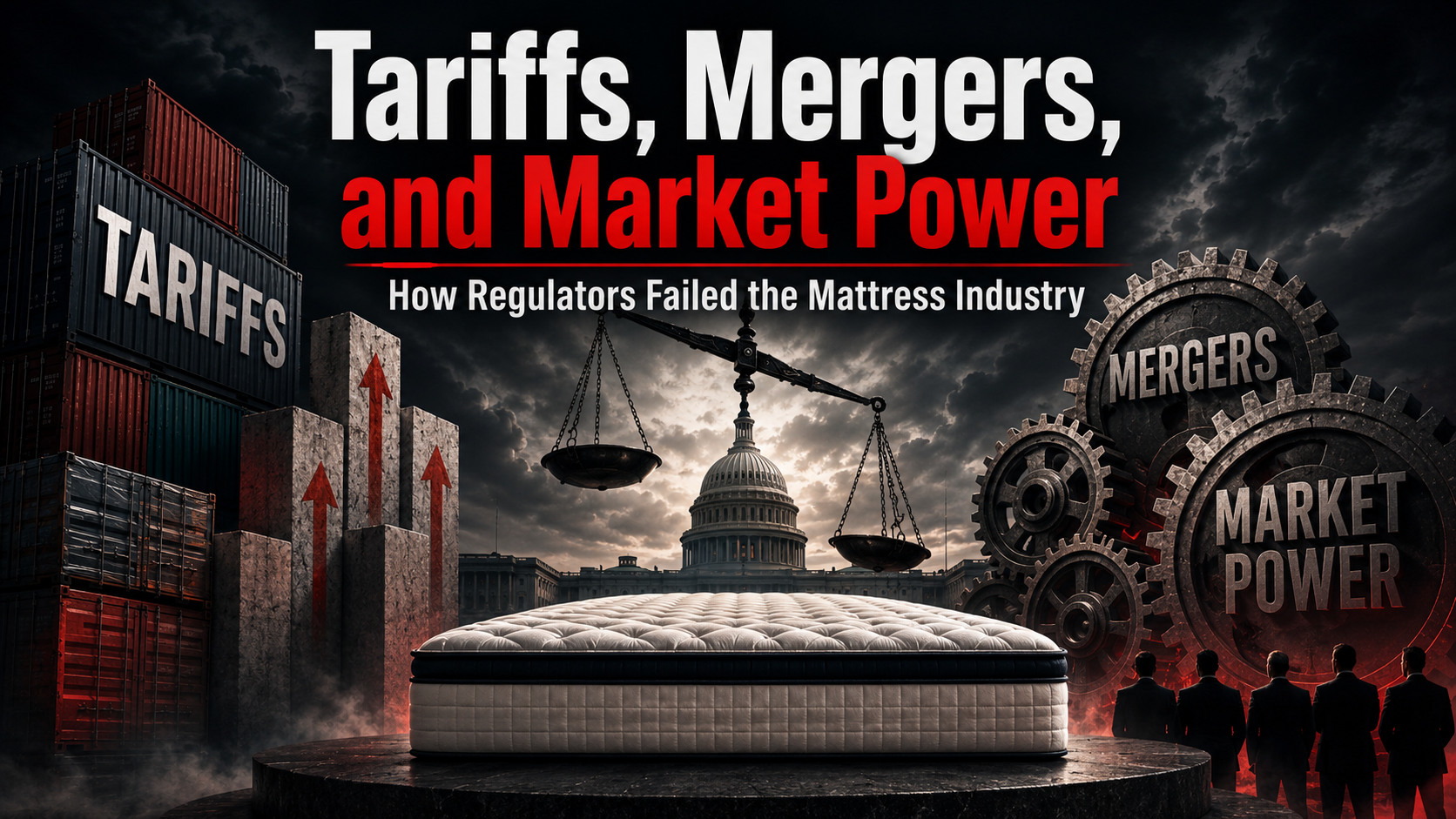
The same federal system that has made importing mattresses and key bedding components more expensive has also failed to stop one of the most aggressive waves of consolidation the industry has ever seen. The result is a marketplace where independent retailers, smaller manufacturers, component suppliers, and consumers are left with fewer true alternatives and less leverage.
That is not a free market. It is a market shaped by federal decisions, federal inaction, and regulatory blind spots.
The first mistake came through trade policy.
Federal agencies imposed antidumping and countervailing duties on imported mattresses after determining that certain imports injured the domestic industry. Some of those cases involved serious allegations of dumping and unfair subsidies. But the real-world effect went far beyond punishing bad actors. Importing finished mattresses from many countries became more expensive, more complex, and more legally risky.
That matters because the mattress industry is not made up only of giant domestic manufacturers. It includes independent retailers, regional producers, private-label brands, warehouse operators, salespeople, delivery teams, and consumers who need affordable sleep products. When trade restrictions raise the cost of imported mattresses or components, the burden does not stop at the port. It travels through the entire supply chain.
A tariff may protect one factory. But it can also raise costs for thousands of small businesses and reduce the number of competitive alternatives available to consumers.
The problem is not that every foreign producer deserves a free pass. Dumping is real. Unfair subsidies are real. But regulators should also ask what happens when trade enforcement becomes so broad that it reduces competition, protects the largest domestic players, and limits the ability of independent retailers to source alternatives.
In theory, regulation is supposed to keep the playing field fair. In practice, this kind of regulation can quietly move the fences.
Then came the second mistake: the Tempur Sealy acquisition of Mattress Firm.
The Federal Trade Commission saw the danger clearly enough to sue. The FTC alleged that Tempur Sealy’s acquisition of Mattress Firm would give the world’s largest mattress supplier and manufacturer both the ability and incentive to suppress competition and raise prices. That concern was not theoretical. Mattress Firm was the nation’s largest mattress specialty retailer. Tempur Sealy was already one of the most powerful manufacturers in bedding.
Combining a dominant supplier with the dominant specialty retail channel raised obvious vertical-integration concerns.
The FTC challenged the transaction. But after losing its effort to stop the deal before closing, Tempur Sealy completed the acquisition of Mattress Firm in February 2025. The company then changed its name to Somnigroup International, with Tempur Sealy, Mattress Firm, and Dreams operating as business units.
Whatever one thinks of the companies involved, the industry structure changed dramatically. One corporate group now controls major bedding brands, significant manufacturing capabilities, and the largest specialty mattress retailer in the country.
For independent retailers and competing manufacturers, that matters.
Even if a vertically integrated company says it will preserve relationships, maintain multi-brand selection, or operate business units separately, regulators should not evaluate these deals based only on promises. They should evaluate incentives.
A company that owns both the factory and the floor space has a natural incentive to favor its own products, its own promotions, its own financing strategy, its own data, and its own long-term distribution goals. That does not require a conspiracy. It is simply how incentives work.
Now federal regulators have allowed another major milestone to pass without a U.S. antitrust challenge: Somnigroup’s proposed acquisition of Leggett & Platt.
Somnigroup and Leggett & Platt announced the proposed transaction in April 2026. The deal is valued at approximately $2.5 billion including debt, and Leggett & Platt is expected to become a direct, wholly owned subsidiary of Somnigroup if the transaction closes. The companies have described the acquisition as part of Somnigroup’s vertical integration strategy.
That alone should have raised serious antitrust questions.
Leggett & Platt is not merely another bedding brand. It is a foundational supplier of bedding components and engineered products used throughout the industry. Somnigroup already owns major mattress brands and the largest specialty mattress retailer. Acquiring a major component supplier would push that vertical integration deeper into the supply chain.
On June 3, 2026, the required 30-day waiting period under the Hart-Scott-Rodino Antitrust Improvements Act expired without U.S. antitrust regulators moving to block the deal. That does not mean the transaction is fully closed. It still remains subject to other closing conditions. But it does mean U.S. antitrust regulators allowed the key federal waiting period to expire without bringing a challenge.
That is a stunning development.
Regulators already watched Tempur Sealy acquire Mattress Firm. Now they have allowed the HSR waiting period to expire on Somnigroup’s proposed acquisition of one of the bedding industry’s most important component suppliers. If this deal closes, the same corporate group would have influence across brands, manufacturing, retail distribution, consumer data, and key upstream components.
That is not ordinary competition. That is an ecosystem.
To be fair, Somnigroup and Leggett & Platt will argue that the deal creates efficiencies, improves product development, strengthens operations, and supports innovation. Those arguments may be sincere. But antitrust review should not stop at the acquiring company’s preferred explanation. The question is not whether executives can describe efficiencies. The question is whether the industry remains meaningfully open, competitive, and fair after the deal.
Regulators should have asked hard questions.
Will independent manufacturers have equal access to critical components?
Will competing bedding brands face higher costs, slower development cycles, or weaker supply terms?
Will independent retailers be squeezed by a company that can influence brands, components, retail placement, financing, data, advertising, and pricing strategy?
Will smaller producers still have a realistic path to compete if tariffs restrict imports while consolidation strengthens the largest domestic players?
Will consumers see more genuine choice, or merely the appearance of choice under fewer corporate umbrellas?
This is where federal policy looks contradictory. On one side, trade regulators have made it harder and more expensive to bring in competing imported mattresses. On the other side, antitrust regulators have failed to prevent the largest domestic players from becoming larger and more vertically integrated.
One policy limits outside competition. The other permits internal consolidation.
Together, those decisions create a dangerous market structure.
A healthy mattress industry needs domestic manufacturing. It also needs independent retailers. It needs regional producers. It needs private-label innovation. It needs fair access to components. It needs lawful imported alternatives. Most of all, it needs a marketplace where the best product, the best service, and the best value can win.
Federal regulators should not pretend tariffs and consolidation are separate issues. They interact. If import restrictions raise the cost of outside competition while mergers consolidate domestic power, the market becomes less competitive from both directions. Consumers may pay more. Independent retailers may have fewer options. Smaller manufacturers may lose leverage. Innovation may increasingly be controlled by a handful of giants instead of tested in a wide-open marketplace.
The mattress industry does not need regulators to pick winners.
It needs regulators to stop building walls around the biggest players.
That means future trade cases should examine not only alleged injury to domestic producers, but also the downstream impact on retailers, consumers, and competitive sourcing. It means merger reviews should focus not only on narrow market definitions, but also on real-world control: brands, stores, components, financing, logistics, consumer data, and supplier incentives.
It also means regulators should be skeptical when the same industry that benefits from trade protection continues consolidating more of the domestic supply chain.
The issue is not whether Somnigroup, Tempur Sealy, Mattress Firm, or Leggett & Platt are bad companies. The issue is whether federal regulators are allowing an industry structure that no competitive market should want: fewer independent suppliers, fewer independent channels, fewer sourcing options, and fewer checks on market power.
That is the failure.
Federal regulators restricted competition from the outside, failed to preserve enough competition on the inside, and have now allowed a key U.S. antitrust waiting period to expire on a deal that could deepen vertical integration across the mattress supply chain.
If this transaction closes without meaningful conditions, the message to the industry will be clear.
Federal regulators are not merely watching consolidation happen.
They are helping build it.